DNS Intelligent Resolution

 Custom Authoritative DNS
 Cloud Computing Services

 Server Rental
 DDoS protection
 About DNS.COM
 Support
 Contact Us
 AFF
AFF
 API Docs

 CN
CN
 EN
EN

Do Expired Domains Still Hold Value? A Comprehensive Guide to Value Sources and Risk Control
In the realms of domain investment and website operations, expired domains are a frequently discussed topic. In the first half of 2026, an average of approximately 50,400 expired domains—within the generic top-level domain (gTLD) category alone—were re-registered daily. On one hand, vast numbers of domains are released due to non-renewal; on the other, investors, enterprises, and even illicit operators scramble to snap them up. Clearly, expired domains are far from being "unwanted waste."
However, "having value" and "generating value for you" are two different things. The sources of value in expired domains are distinct, as are the associated risks. Only by understanding both aspects can one make informed decisions regarding domain investment and website development.
What Exactly Does "Expired" Mean for a Domain?
When a domain expires, it is not released immediately; instead, it passes through three distinct stages.
The grace period typically lasts around 30 days; the domain remains the property of the original holder and can be renewed at the standard rate. The redemption period lasts about 30 days; the original holder can still recover the domain but must pay a redemption fee significantly higher than the standard renewal cost. The deletion period lasts approximately 5 days; the domain cannot be recovered, and the registry will release it back into the pool of publicly available domains once this period ends. Counting from the expiration date, the entire cycle takes about 65 days before the domain officially enters the open market.
This means that truly "competitive" expired domains are identified, evaluated, and snapped up during this window. By the time a domain is actually released to the public, high-quality assets have often already been secured by players who acted sooner.
Inheritable Value: Backlinks, Traffic, and Brand Recognition
The reason expired domains are considered to possess "inherent value" lies primarily in three elements that can be carried over to a new owner.
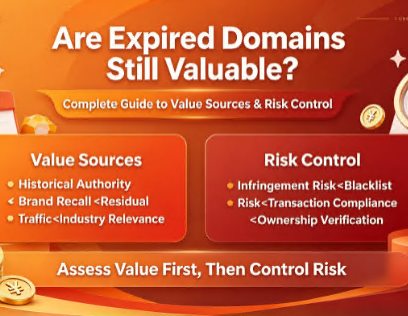
High-quality backlinks are the primary source of value. Google’s link signals often persist even after a domain changes ownership. If these backlinks originate from reputable websites within a relevant industry, they represent an asset for the new site that would be impossible to accumulate quickly from scratch. However, there is a prerequisite: the subject matter of the backlinks must align with the content of the new site. Links inherited from unrelated industries—no matter how old the domain is—offer extremely limited benefits for the new site's search rankings. Historical traffic and brand recall constitute a secondary layer of value. Some domains that once commanded a stable user base continue to attract visitors who type the domain directly into their browsers, even after operations have ceased. This type of "type-in" traffic is highly targeted; if a new site's business aligns with the original domain's purpose, conversion rates can be far superior to those of a brand-new domain starting from scratch. In 2026, the established French portal Lycos.fr sold for €35,300; its value stemmed primarily from brand recognition, direct type-in traffic, and its historical track record.
Short, memorable domains also offer value for brand repurposing. Pinyin or English domains that align closely with industry keywords retain their brand recall value even after operations stop. When a new brand adopts such a domain, it can quickly capture user attention by leveraging the domain's inherent memorability, bypassing the need to build brand awareness from zero.
It is important to clarify a common misconception: expired domains do not automatically gain ranking advantages simply due to their "age." Google’s John Mueller has explicitly stated that domain age "doesn't help at all." What truly drives rankings are backlinks relevant to the target content, not the number of years a domain has been registered. When purchasing an expired domain, you are buying the "network of connections it once built," not the "duration of its existence."
What gets reset: pages, rankings, and "instant authority"
While understanding what value can be inherited is crucial, it is equally important to understand what gets reset to zero.
Previously indexed pages and rankings drop out of the index once a domain expires. When a domain expires and the site goes offline, Google gradually removes its pages from the index. You cannot expect to inherit existing keyword rankings simply by purchasing an expired domain. Rebuilding content, getting re-indexed, and regaining rankings is a process that still takes time.
"Domain authority" does not instantly activate the moment of purchase. Google has explicitly stated that it does not use third-party domain authority scores as ranking factors. An expired domain's "reputation" must be rebuilt based on the backlinks that have survived. Sellers marketing "high-DA (Domain Authority) expired domains" are selling a reference metric, not an asset that translates directly into rankings. Four Types of Risks to Avoid
The risks associated with expired domains are not merely vague concerns about "potential usability issues"; they fall into specific, detectable categories.
The first category is a history of SEO penalties. If a previous owner incurred a manual penalty from Google due to spam or policy violations, the new owner must submit a reconsideration request—with no guarantee of a quick "clean slate." Before purchasing, you should check Google Search Console for records of manual actions or use third-party tools to investigate the domain's penalty history.
The second category is toxic backlinks. A large volume of low-quality or irrelevant backlinks can drag down rankings. Cleaning up these links requires significant time and effort; sometimes, the cost of remediation exceeds the value of the domain itself. Using tools like Ahrefs or SEMrush to analyze the quality distribution of backlinks is an essential step in the evaluation process.
The third category involves trademark and reputational risks. A domain that is identical or highly similar to an existing registered trademark could face infringement claims or even trigger UDRP arbitration proceedings. More insidious is the reputational baggage: a domain previously associated with scams, adult content, or commercial disputes—even one with impressive backlink metrics—can carry a difficult-to-shake legacy that hinders rebranding efforts.
The fourth category is the risk of exploitation by cybercriminals. Criminal groups have invested millions of dollars in acquiring expired domains, leveraging their established reputations and traffic to distribute malware or launch phishing attacks. While this is the work of illicit actors, it highlights the potential for abuse within the expired domain market. For legitimate buyers and sellers, understanding this risk encourages prudence during transactions and underscores the importance of choosing reputable marketplaces.
How to Evaluate Whether an Expired Domain Is Worth Acquiring
A practical evaluation process can be carried out in the following order:
Check the history first, then examine the data. Use Archive.org to review the domain's past content and confirm it was a legitimate site with no history of policy violations. The relevance of its past use to your current business direction is more important than the sheer number of backlinks.
Next, verify the quality of the backlinks. Use Ahrefs or SEMrush to examine the distribution of "Referring Domains." If backlinks are heavily concentrated on a few irrelevant sites or originate largely from low-quality directories, the domain's backlink value is limited. Fifty links from authoritative sites in a relevant industry are far more valuable than five hundred links from "spam" sites.
Next, screen for penalties and trademark risks. Check Google Search Console for any records of manual actions. Use the USPTO or the China Trademark Office database to verify if the domain conflicts with existing registered trademarks. If the domain was previously used for a business associated with a well-known brand, the trademark holder might still assert their rights, even if the original owner has abandoned the domain.
Finally, evaluate the domain's potential for branding. Factors such as length, spelling complexity, ease of pronunciation, and industry associations determine whether users will actually remember and type the domain correctly for your new business. A domain that once generated high traffic but is completely unrelated to your business direction—no matter how impressive its backlink profile—may see very slow ranking recovery after being rebuilt.
Whether an expired domain is worth acquiring depends on how you use it.
Returning to the initial question: Do expired domains still hold value?
They do, but that value is conditional. An expired domain with a clean history, relevant industry backlinks, and branding potential can indeed save a new site the time required to build authority from scratch. Conversely, a domain with a history of penalties, toxic backlinks, or trademark disputes will only become a burden if purchased.
For businesses and brands, the most pragmatic approach is to focus on defensive measures. Regularly monitor the status of core brand domains and enable auto-renewal to prevent domains from entering the redemption period due to oversight. Once a domain expires, not only is business disrupted, but brand assets also risk being exploited by third parties. The cost of renewing in advance is negligible compared to the high price of redeeming or re-registering a domain after the fact.
For investors and site builders, the rigor of the evaluation process determines the return on investment. The value of an expired domain lies not in the state of "expiration" itself, but in its "history"—specifically, whether that history is clean, the backlinks are relevant, and the brand identity is reusable. Thoroughly verifying each of these dimensions before deciding whether to place a bid is the most fundamental way to manage risk.
 Latest Posts



 Online Customer service